Add Shape Attributes Low Fast
This tool incorporates multiprocessing capability to speed up the calculation performance. It is thus more efficient in generating profile attributes for each bathymetric low feature. Essentially, this tool opens multiple Python windows depending on the Number of CPU processors parameter. Each of these Python windows processes a subset of input features. After completing the multiprocessing, the results are merged as the final output.
This tool add a number of shape attributes to the input bathymetric low feature class as described in Wirth, M.A. Shape Analysis & Measurement.
The following attributes are calculated to describe the polygon shape of each bathymetric low feature.
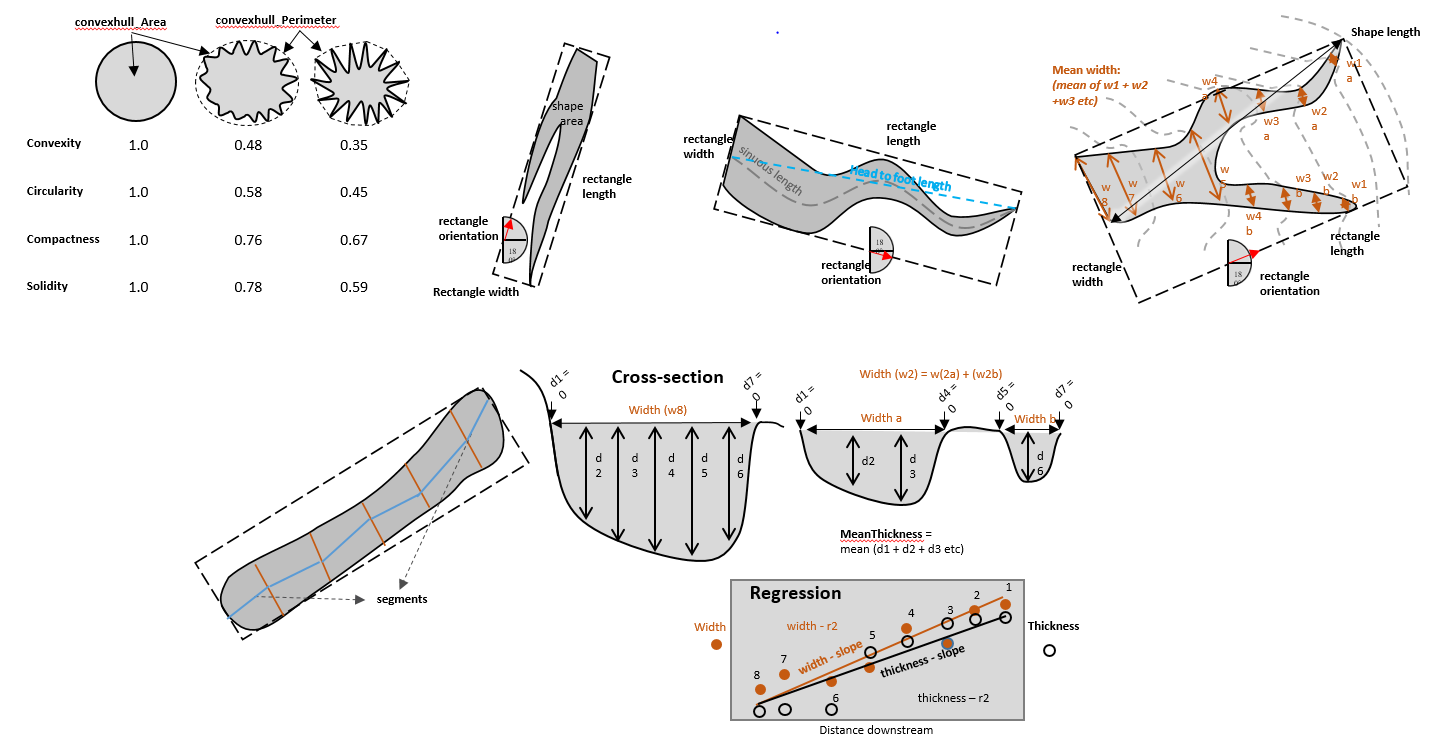
head_foot_length: the euclidean distance between the head and the foot of the feature polygon, along the long axis
sinuous_length: the sinuous distance between two ends of the feature polygon, along the long axis
mean_width: the mean width of the feature polygon, calculated from a number of cross-sections perpendicular to the orientation of the feature polygon
mean_thickness: the mean thickness of the feature polygon, calculated from a number of cross-sections perpendicular to the orientation of the feature polygon. The thickness of a cross-section is calculated as the depth difference between the deeper end of the cross-section and the deepest point on the bottom of the cross-section
mean_width_thickness_ratio: the mean width to thickness ratio of the feature polygon, calculated from a number of cross-sections perpendicular to the orientation of the feature polygon. The width to thickness ratio of each cross-section is calculated as width/thickness
std_width_thickness_ratio: the standard deviation of width to thickness ratio of the feature polygon, calculated from a number of cross-sections perpendicular to the orientation of the feature polygon. The width to thickness ratio of each cross-section is calculated as width/thickness
mean_segment_slope: the mean slope gradient of thalweg segments of the feature polygon. The thalweg segments are the line segments linking the deepest points of the cross-sections perpendicular to the orientation of the feature
width_distance_slope: the slope of the linear regression line between two variables: the widths of the cross-sections and the distances of the cross-sections to the head of the feature polygon
width_distance_correlation: the Pearson correlation coefficient between two variables: the widths of the cross-sections and the distances of the cross-sections to the head of the feature polygon
thick_distance_slope: the slope of the linear regression line between two variables: the thicknesses of the cross-sections and the distances of the cross-sections to the head of the feature polygon
thick_distance_correlation: the Pearson correlation coefficient between two variables: the thicknesses of the cross-sections and the distances of the cross-sections to the head of the feature polygon
Compactness: Describe how compact the feature polygon is. More complex polygon shape has a lower compactness. It is calculated by equation (1), where A is the area of the polygon, P is the perimeter of the polygon
(1)¶\[\frac{4 * \pi * A}{P^2}\]
Sinuosity: Describe the sinuosity of the feature polygon. Larger the value more sinuous the feature polygon is. It is calculated by equation (2)
(2)¶\[\frac{sinuous\_length}{head\_foot\_length}\]
LenghWidthRatio: Describe the length to width ratio of the feature polygon. Larger the value more elongate the feature polygon is. It is calculated by equation (3)
(3)¶\[\frac{sinuous\_length}{mean\_width}\]
Circularity: Describe how close the feature polygon is to a circle. Larger the value closer to a circle the feature polygon is. It is calculated by equation (4), where Pc is the perimeter of the convex hull polygon that bounds the feature polygon.
(4)¶\[\frac{4 * \pi * A}{Pc^2}\]
Convexity: Describe the convexity of the feature polygon. More complex polygon has a lower convexity. It is calculated by equation (5)
(5)¶\[\frac{Pc}{P}\]
Solidity: Describe the solidity of the feature polygon. More complex polygon has a lower solidity. It is calculated by equation (6)
(6)¶\[\frac{A}{Ac}\]
In addition, a number of intermediate attributes are also calculated:
rectangle_Length: the length of the bounding rectangle (by width) that bounds the feature polygon
rectangle_Width: the width of the bounding rectangle (by width) that bounds the feature polygon
rectangle_Orientation: the orientation of the bounding rectangle (by width) that bounds the feature polygon
convexhull_Area: the area of the convex hull that bounds the feature polygon
convexhull_Perimeter: the perimeter of the convex hull that bounds the feature polygon